In metric topology the notion of a circle isn't always intuitively the same as a standard "round" circle. Normally, we think of circles on the plane as being all of the points that are a certain distance away, called the "radius", from some center point. This is fine for everyday usage and will certainly get you through traffic circles, but what exactly do we mean by "distance"?
You're probably thinking, "It's just how far away two points are, why are you asking me" which again is true in the standard, boring metric space that mathematicians call "Euclidian space" and normal people call "real life." Clearly if you want to find the distance between two points, just make a straight line between them and measure the length.
Okay so what's a straight line? What if it's not obvious what a "straight line" is: think of when you take a flight over a long distance. If you looked at a flat map of the world and looked at the flight path, it certainly doesn't look like a straight line.

That's because you're flying over a sphere, and straight lines on the sphere don't show up as straight on a flat map. So the distance is not always obvious from looking at a picture.
Now this example has a pretty easy fix: just get a better "map" of the Earth, like a globe. But what if I just told you the distance between two points, as a function? Let's say I give you two points on this plane:
 And I said we're going to call the "distance" between two points the vertical difference between them, so we're going to completely ignore how far left or right they are from each other. The points (0,0) and (3,1) are a distance 1 apart, as are (0,0) and (0,-1). This new "distance" is called a metric on our plane.
Let's make this precise: we're going to define the distance between a point (x,y) and (a,b) as d{(x,y),(a,b)} = |y - b|. Note that x and a do not play any role in the distance, showing why the left/right movement is ignored. We also see that there's an absolute value involved, since distances are always positive.
Now that we have a new metric, let's go back to circles. What is a circle again? It's just the set of all points a certain distance away from the center. Well now we have a new notion of distance. Let's find a circle in this new space: All the points a distance 1 away from the center are just the points that are a height 1 above the origin or -1 below. We can solve the above equation by setting the point (x,y) to be the origin (0,0) and setting d = 1. We obtain 1 = |b| so that b = 1, -1. So we'll graph all the points that have a y-coordinate of 1 or -1, and this gives us the circle in this metric:
Huh. Well it's not very round. But it is indeed a circle, since it fits the definition perfectly: all of the points on these lines are a "distance" of 1 away from the center.
We can also find pi of this new circle, since pi is just the circumference divided by the diameter. While the radius is 1, the circumference is infinite, since each line is infinitely long! So pi is infinity for this circle.
Let's do some more metrics. Note that these are all telling us the distance between the points (x,y) and the origin (0,0). How about this one:
 This looks a lot like the Pythagorean Theorem. Wait a minute...this is just the straight-line Euclidian distance! So we know that circles in this metric are just "normal" circles. We know that pi = 3.14...
How about this one:
 Well here it looks like we're taking the vertical distance |y|, and adding the horizontal distance |x| to get our total distance. This is called taxicab geometry, or "Manhattan distance" since to get to any point you can only go in a "grid":
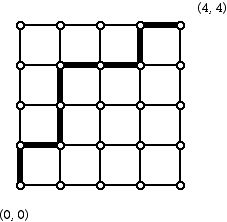
What do circles look like here? Well we need to take all the points that are a taxicab distance 1 from the origin. It ends up looking like this:

If you imagine starting at any of those points on this "circle" and going to the origin only up/down and left/right separately, you'll always get 1.
So what's pi? Well the circumference now is 8 (each side of this diamond has a length of 2, think of traveling from one corner to another along the axes), and the diameter is clearly 2. So pi = 4!
Okay now let's really get started. These last two were part of a sequence of metrics of this form:
 It's hard to see at first, but imagine if p = 2. Then you get the standard Euclidian metric with normal round circles. If p = 1, you get the taxicab geometry we had above. In mathematics, the numbers usually go 1, 2, infinity. If p = infinity, well then we have a problem! But think about it this way: when you let p get really big, and lets say x is a little bigger than y, then |x|^p is huge compared to |y|^p, so we can just ignore the y term. Then we're taking the whole thing (which is now just the x) to the power of 1/p, which cancels the p power of the x. So the whole thing becomes d = |x|. But if y was bigger than x, it would be d = |y|. In general, we actually (surprisingly) get d = max{x, y}. Basically we pick which one is the maximum.
Now let's graph the circle! Well as long as x is bigger, the distance is just the x value, but as soon as y gets bigger the distance becomes the y value. So to graph the points of distance 1 from the origin, it's going to just be where the x value is 1 until y is larger, then it's just where y = 1. This sounds like a square!

So here's a circle in this p = infinity metric. Note that it looks a lot like the taxicab circle, and in face the circumference is also 8 and diameter is 2. So pi is once again 4.
While nothing would be more fun than to plug in uncountably many values for p, I'll just summarize what happens: You can put any value of p greater than or equal to 1 find a value for pi, but as we saw, the "endpoints" of p (that is, 1 and infinity) give pi = 4. It turns out if you graph every value for p, you get a global minimum at p = 2 where pi = 3.1415...
So rest easy with the knowledge that the standard circle you know and love is indeed, mathematically, the roundest circle.
You're probably thinking, "It's just how far away two points are, why are you asking me" which again is true in the standard, boring metric space that mathematicians call "Euclidian space" and normal people call "real life." Clearly if you want to find the distance between two points, just make a straight line between them and measure the length.
That's because you're flying over a sphere, and straight lines on the sphere don't show up as straight on a flat map. So the distance is not always obvious from looking at a picture.
Now this example has a pretty easy fix: just get a better "map" of the Earth, like a globe. But what if I just told you the distance between two points, as a function? Let's say I give you two points on this plane:
Let's make this precise: we're going to define the distance between a point (x,y) and (a,b) as d{(x,y),(a,b)} = |y - b|. Note that x and a do not play any role in the distance, showing why the left/right movement is ignored. We also see that there's an absolute value involved, since distances are always positive.
Now that we have a new metric, let's go back to circles. What is a circle again? It's just the set of all points a certain distance away from the center. Well now we have a new notion of distance. Let's find a circle in this new space: All the points a distance 1 away from the center are just the points that are a height 1 above the origin or -1 below. We can solve the above equation by setting the point (x,y) to be the origin (0,0) and setting d = 1. We obtain 1 = |b| so that b = 1, -1. So we'll graph all the points that have a y-coordinate of 1 or -1, and this gives us the circle in this metric:
 |
| A circle in the vertical metric. |
We can also find pi of this new circle, since pi is just the circumference divided by the diameter. While the radius is 1, the circumference is infinite, since each line is infinitely long! So pi is infinity for this circle.
Let's do some more metrics. Note that these are all telling us the distance between the points (x,y) and the origin (0,0). How about this one:

How about this one:

If you imagine starting at any of those points on this "circle" and going to the origin only up/down and left/right separately, you'll always get 1.
So what's pi? Well the circumference now is 8 (each side of this diamond has a length of 2, think of traveling from one corner to another along the axes), and the diameter is clearly 2. So pi = 4!
Okay now let's really get started. These last two were part of a sequence of metrics of this form:

Now let's graph the circle! Well as long as x is bigger, the distance is just the x value, but as soon as y gets bigger the distance becomes the y value. So to graph the points of distance 1 from the origin, it's going to just be where the x value is 1 until y is larger, then it's just where y = 1. This sounds like a square!

So here's a circle in this p = infinity metric. Note that it looks a lot like the taxicab circle, and in face the circumference is also 8 and diameter is 2. So pi is once again 4.
While nothing would be more fun than to plug in uncountably many values for p, I'll just summarize what happens: You can put any value of p greater than or equal to 1 find a value for pi, but as we saw, the "endpoints" of p (that is, 1 and infinity) give pi = 4. It turns out if you graph every value for p, you get a global minimum at p = 2 where pi = 3.1415...
So rest easy with the knowledge that the standard circle you know and love is indeed, mathematically, the roundest circle.
Comments
Post a Comment